
10 July 2026
How Private Surveillance Works
Learn how private surveillance works, from planning and legal limits to evidence collection, reporting, and when a licensed investigator adds value.
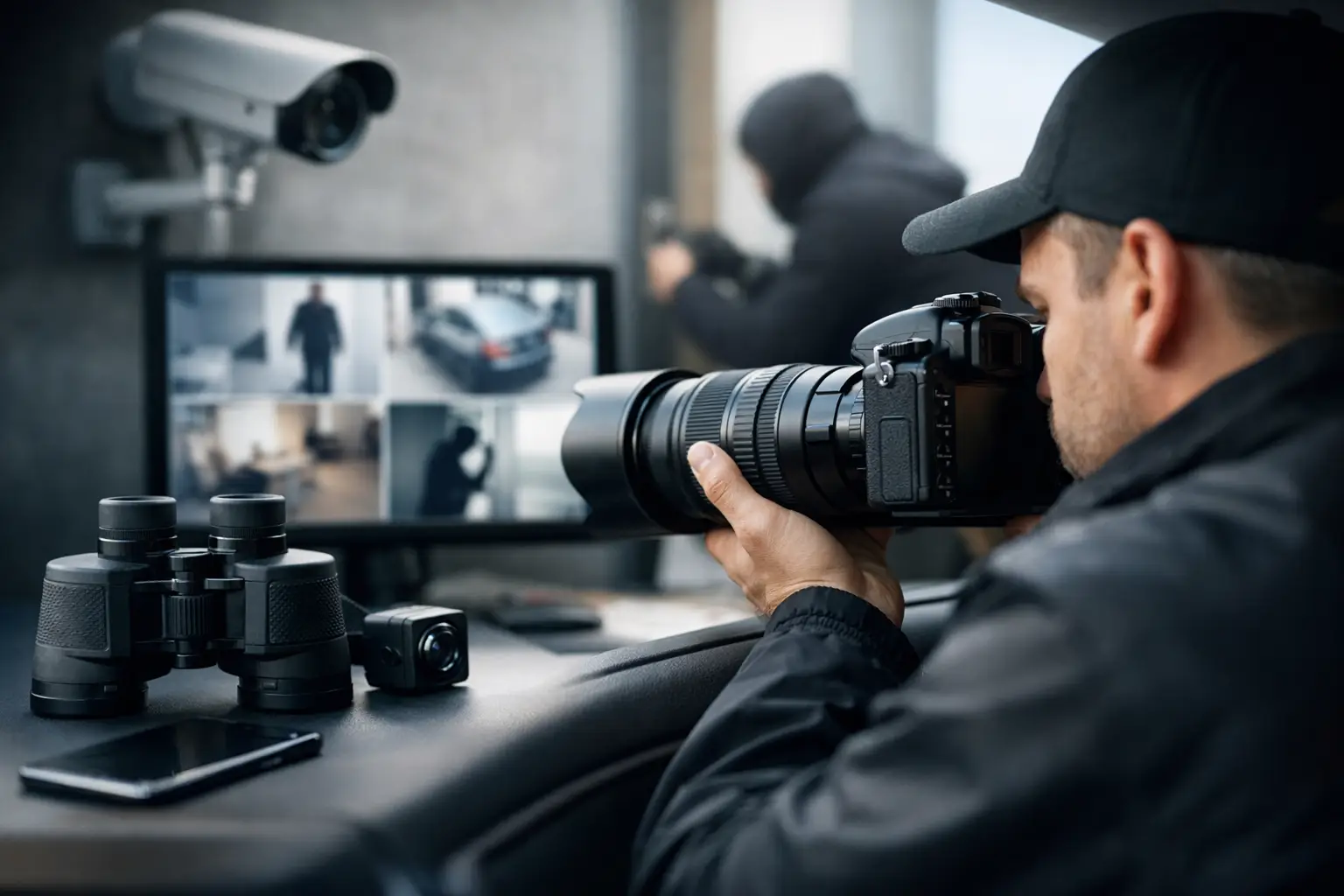
You usually ask how private surveillance works when suspicion has already disrupted your routine. A spouse’s unexplained absences, an employee’s inconsistent claim, a partner’s unusual transactions, or a missing person concern can leave you stuck between instinct and proof. Private surveillance exists to replace guesswork with documented facts gathered lawfully, discreetly, and with a clear investigative purpose.
At its core, private surveillance is the structured observation of a person, location, activity, or pattern of behavior to establish what is actually happening. It is not random watching, and it is not cinematic espionage. A professional investigator begins with an allegation, concern, or risk question, then builds an operational plan designed to collect relevant evidence without alerting the subject or crossing legal boundaries.
How private surveillance works in practice
The process starts long before any field operative takes position. A licensed investigator first defines the objective. That objective might be to verify suspected infidelity, confirm whether a worker is exaggerating an injury, identify unauthorized contact with a competitor, document a child custody concern, or establish movement patterns tied to fraud or misconduct. Without a defined objective, surveillance becomes inefficient and legally risky.
The next step is case assessment. This includes reviewing the client’s information, timeline, known addresses, vehicles, routines, photographs, employment details, and any previous incidents. The investigator evaluates whether surveillance is the right tool or whether other methods, such as background checks, interviews, records review, or digital analysis, should support the case. Good agencies do not treat surveillance as the answer to every problem. In some matters, observation alone will not produce the evidence needed.
Once the objective is clear, the investigator develops a surveillance plan. This covers likely locations, time windows, staffing requirements, transportation, communication procedures, and evidence priorities. A subject with a fixed office schedule is handled differently from someone who travels unpredictably across multiple locations. A corporate case involving inventory diversion may require observation near a warehouse or handoff point. A matrimonial matter may require evening and weekend coverage because that is when relevant activity occurs.
Planning matters more than most clients realize
Many people imagine surveillance as a single investigator parked outside a building with a camera. Sometimes it is that simple. More often, effective surveillance depends on preparation, patience, and adaptability. Timing is critical. If the investigator watches the right place at the wrong time, the result is still a missed opportunity.
This is why professional surveillance often uses intelligence-led scheduling. Patterns are analyzed first, then resources are deployed where the likelihood of evidentiary activity is highest. In sensitive cases, investigators may use more than one operative to reduce the chance of losing sight of the subject in traffic, crowded areas, or multi-stop movement. That does increase cost, but it can materially improve continuity and evidence quality.
Trade-offs are part of the process. Longer surveillance windows may produce better pattern analysis but can also increase expense. Tighter budgets may require focusing only on high-probability periods. A credible investigator should explain those choices clearly rather than overpromising constant visibility.
The role of discretion in surveillance operations
Discretion is not just a courtesy. It is operationally necessary. If a subject becomes aware of surveillance, behavior often changes immediately. That can compromise the investigation, distort evidence, or create unnecessary confrontation.
Professional surveillance therefore relies on low-visibility methods. Investigators blend into the environment, maintain controlled distance, vary positioning, and avoid predictable patterns. They document observations carefully while minimizing any conduct that might draw attention. In a business investigation, that may mean observing from public vantage points and monitoring movement around a site without disrupting operations. In a personal matter, it may mean following a subject through changing locations while preserving continuity and avoiding detection.
What investigators actually collect
The purpose of surveillance is evidence, not suspicion. That evidence may include time-stamped photographs, video documentation, observation notes, movement logs, vehicle details, contact patterns, location sequences, and corroborating factual records. The exact form depends on the case objective.
For example, in an infidelity case, useful evidence may involve documented meetings, overnight stays, or repeated contact inconsistent with the explanation given to a spouse. In a workplace misconduct case, the key evidence might be off-site meetings, unauthorized loading activity, unexplained visits to a competitor, or behavior inconsistent with reported medical restrictions. In a missing person or family-related matter, surveillance may help confirm presence at a location, known associates, or recurring movement patterns.
Not every surveillance operation produces dramatic footage. Sometimes the value lies in establishing consistency, contradiction, or absence. Evidence that a person did not attend the location they claimed, did not remain home as stated, or repeatedly met with a previously undisclosed contact can be highly significant. Quiet factual contradictions often matter more than sensational moments.
Legal limits shape how private surveillance works
A critical part of how private surveillance works is understanding what investigators can and cannot do. Lawful surveillance is not the same as unrestricted observation. A professional agency operates within applicable legal and regulatory boundaries, and that matters because improperly obtained evidence can damage a client’s position rather than strengthen it.
In practical terms, investigators must consider privacy laws, trespass restrictions, harassment risks, evidence handling standards, and the rules that affect whether findings can support legal or internal action. Surveillance is generally strongest when it focuses on lawful observation from appropriate locations and on documentation that can be authenticated, dated, and explained clearly in a report.
This is one reason licensed firms carry more value than informal operators. A trained investigator understands chain of custody, report discipline, evidentiary relevance, and the difference between information that is merely interesting and information that is actually usable. For clients facing litigation, employment disputes, divorce proceedings, or insurance scrutiny, that distinction is not minor.
Reporting is where surveillance becomes actionable
Surveillance is only useful if the findings are organized into a report that a client, lawyer, insurer, or decision-maker can understand. Raw photos without context rarely help. Professional reporting connects observations to dates, times, locations, and the stated objective of the assignment.
A proper surveillance report typically explains what was tasked, when coverage was conducted, what was observed, what evidence was captured, and where limitations affected the result. If no relevant activity occurred, that should be stated plainly. Honest negative findings are part of credible investigative work. Inflated reporting may sound persuasive in the short term but can collapse under scrutiny.
The strongest reports are factual and restrained. They avoid speculation and stick to what can be observed, documented, and defended. That approach protects the client. It also makes the findings more useful for legal counsel, HR teams, compliance officers, or family law proceedings where precision matters.
When surveillance is the right choice
Surveillance is most effective when behavior needs to be verified in the real world. It is often appropriate where there is a clear concern but insufficient proof, such as suspected infidelity, employee misconduct, fraudulent claims, hidden business relationships, child welfare concerns, or unexplained movements tied to financial or legal disputes.
It is less effective when the question is purely historical and leaves no ongoing behavioral trail, or when the client is looking for certainty from a single short observation window. Human behavior is irregular. Some subjects are predictable. Others are not. A credible agency should explain that surveillance can reveal patterns and incidents, but results depend on timing, subject activity, environment, and the quality of the intelligence provided at the start.
For that reason, surveillance often works best as part of a broader investigative strategy. Background checks can identify connections. Digital forensics can clarify device activity. Interviews can test explanations. Records analysis can expose inconsistencies. Observation then helps confirm what those indicators mean in practice.
Why professional execution matters
The difference between amateur watching and professional surveillance is discipline. A licensed investigator is not simply trying to catch someone doing something wrong. The goal is to establish facts in a controlled, confidential, and defensible way. That requires planning, legal awareness, operational judgment, and patience.
It also requires emotional distance. Clients often come to surveillance matters under stress, and that is understandable. But good investigative work is not driven by anger or assumption. It is driven by method. Agencies such as Baker Street Private Investigator are engaged for exactly that reason: to handle sensitive matters discreetly, preserve confidentiality, and produce evidence that supports informed action rather than emotional reaction.
If you are considering surveillance, the right first question is not how quickly someone can start watching. It is whether the objective is clear, lawful, and worth pursuing through a structured investigation. When the process is handled correctly, private surveillance does more than confirm suspicion. It gives you a factual basis to decide what comes next.