
Surveillance Services Singapore: What to Expect
Learn how surveillance services Singapore work, when to hire a licensed investigator, what evidence you may receive, and what affects case results.
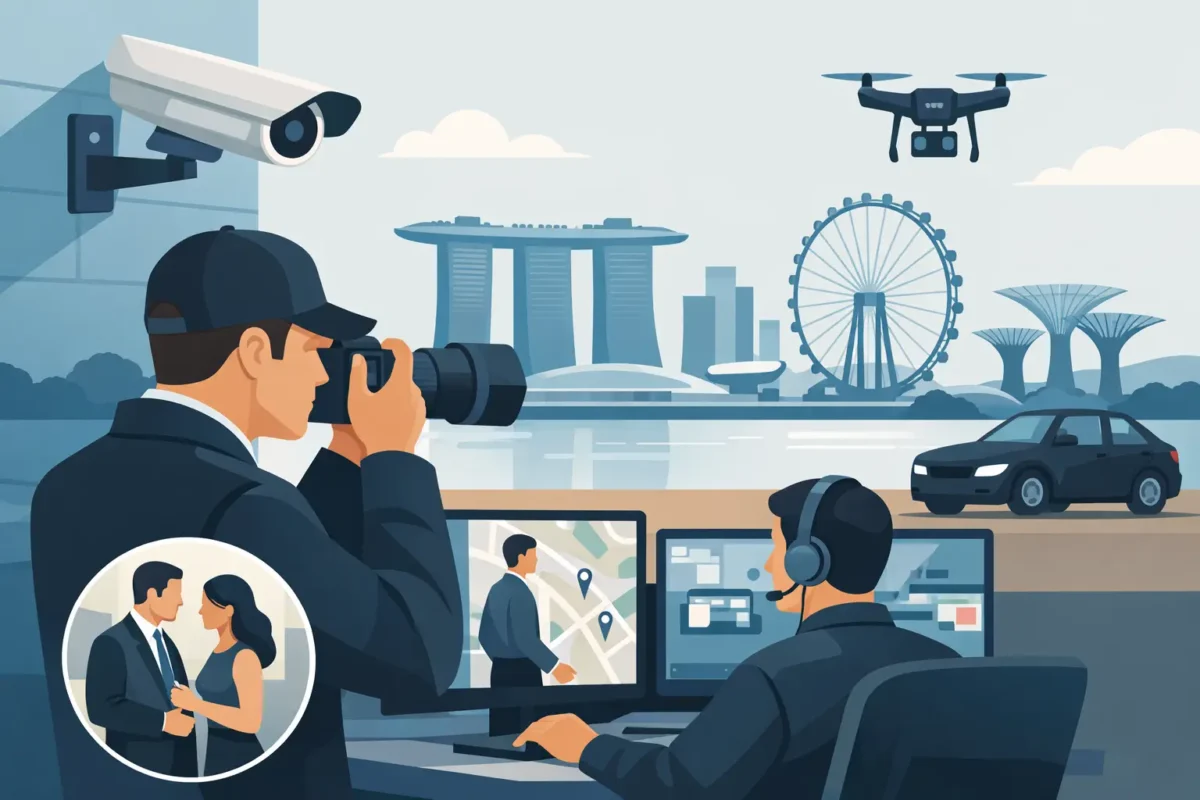
When suspicion starts affecting your decisions, waiting rarely makes matters easier. Whether the concern is a spouse’s unexplained behavior, an employee’s misconduct, a fraudulent claim, or activity that puts a business at risk, surveillance services Singapore are often the fastest way to replace doubt with verified facts.
Surveillance is not simply following someone and taking photographs. In a professional investigation, it is a controlled evidence-gathering process built around legality, discretion, timing, and accurate reporting. The quality of the work matters because the findings may influence family decisions, internal disciplinary action, insurance disputes, or legal proceedings.
What surveillance services Singapore actually involve
Professional surveillance begins with a case assessment. An investigator studies the objective, the subject’s known habits, the locations involved, the timeframe, and the client’s intended use of the evidence. A spouse suspected of infidelity requires a different approach than an employee suspected of moonlighting during medical leave or a claimant suspected of exaggerating injuries.
From there, the agency develops an operational plan. That plan may include fixed-point observation, mobile surveillance, photographic documentation, video capture, timestamped notes, and coordination between investigators when movement between locations is likely. The goal is not constant activity. The goal is to document relevant behavior clearly, without interfering, exposing the operation, or crossing legal lines.
That distinction matters. Good surveillance is patient, disciplined, and selective. Investigators are not there to speculate. They are there to observe, record, and report what can be supported by evidence.
When surveillance is the right investigative tool
Surveillance is useful when the core question depends on conduct rather than records alone. If you need to know what a person is doing, where they are going, who they are meeting, or whether their claimed limitations match their actual behavior, surveillance can be highly effective.
For private clients, common triggers include suspected infidelity, child custody concerns, cohabitation issues, hidden routines, and missing-person leads where movement patterns still exist. For business clients, the need often arises in cases involving employee theft, unauthorized outside work, false expense behavior, suspicious meetings with competitors, workman compensation claims, and internal misconduct that occurs offsite.
It does not solve every case. If the issue turns mainly on digital activity, financial records, or historical relationships, another service such as digital forensics, background checks, or document-based investigation may be more appropriate. In many cases, the strongest strategy combines surveillance with other methods rather than relying on one tool alone.
Why licensing and compliance matter
A surveillance assignment can create valuable evidence, but only if it is collected properly. In Singapore, investigative work should be handled by a licensed agency that understands operational boundaries, evidence handling, and reporting standards. That is not a technical detail. It affects whether the findings are credible, whether the investigation stays within lawful limits, and whether the client is protected from careless methods.
A professional agency should be able to explain how it approaches confidentiality, field procedures, documentation, and case reporting. It should also be realistic about outcomes. No ethical investigator can promise that every subject will produce useful activity during the first deployment. Human behavior is variable, and some cases require several sessions to establish patterns or capture decisive evidence.
This is where experience matters. Investigators with law-enforcement or casework backgrounds tend to be stronger at identifying what is relevant, preserving chronology, and documenting facts in a way that supports follow-up action rather than creating noise.
What kind of evidence you may receive
Clients often ask what a surveillance report looks like. In a properly handled case, the final output usually includes a written report, an activity timeline, photographs or video where available, and observations tied to dates, times, and locations. The standard should be factual and court-conscious, not dramatic.
That means the report should avoid assumptions. If a subject entered a building at 7:42 p.m. and exited with another person at 10:11 p.m., that is recorded. If the investigator observed physical interaction, a vehicle transfer, or conduct inconsistent with a claimed injury, that is documented. The report should not guess at motives or make claims that cannot be supported.
For private individuals, this evidence can provide clarity for personal decisions, legal consultation, or family proceedings. For companies, it can support internal investigations, HR action, insurance review, or consultation with legal counsel. The cleaner the documentation, the more useful it becomes.
What affects surveillance results
Not every surveillance operation produces the same volume or quality of evidence. Results depend on the subject’s routine, the accuracy of the starting information, the environment, and the length of the assignment.
If the subject has a predictable schedule and known vehicle, surveillance is generally more efficient. If the person changes routines often, uses multiple transportation methods, or spends most of the day inside controlled-access buildings, the work becomes more complex. Urban environments can help and hurt at the same time. Crowded areas provide cover for investigators, but they also create visibility challenges and sudden route changes.
Timing is another major factor. A four-hour operation may be enough if the target activity happens within a narrow window. In other cases, especially infidelity or fraud matters, the first session only establishes a pattern that informs later deployments. Clients should expect a professional agency to discuss these trade-offs clearly before work begins.
Surveillance for personal matters
Personal investigations require a measured approach because the facts often carry emotional weight. If a client suspects infidelity, the real need is usually not surveillance itself. The need is certainty. Acting without evidence can damage relationships, complicate custody issues, and create unnecessary conflict. Acting with verified information allows for more controlled decisions.
The same applies to custody-related concerns or pre-marital due diligence. If a child’s welfare may be affected by undisclosed behavior, substance use, or unsafe associations, surveillance can help establish observable facts. But these cases require restraint. The objective is to gather defensible information, not escalate family tension.
A discreet agency understands that personal clients are often under pressure. Clear communication, confidentiality, and realistic expectations are as important as field capability.
Surveillance for business risk and misconduct
For companies, surveillance is often about protecting assets, staff, and decision-making. An employer may suspect that an employee on medical leave is working elsewhere. A management team may need to verify unauthorized meetings, misuse of company time, or conduct inconsistent with internal claims. In workman compensation cases, evidence may be needed to test whether reported physical limitations align with actual behavior.
These matters are sensitive because a poor investigation can expose the company to legal and reputational risk. Surveillance should not be used as a shortcut for weak internal processes. It should be part of a deliberate response where there is a defined concern, a legitimate objective, and a plan for how the evidence will be reviewed.
This is one reason business clients often prefer agencies that can align surveillance with broader investigative support, including reporting that is structured for legal counsel, HR, insurers, or senior management. Baker Street Private Investigator is one example of a licensed agency that approaches surveillance this way, with discretion and evidence-led reporting at the center of the assignment.
How a professional engagement usually works
Most surveillance cases start with a confidential consultation. The client explains the concern, shares known facts, and outlines the desired outcome. The agency then assesses whether surveillance is appropriate, what level of coverage may be required, and what legal and operational constraints apply.
Once the case is accepted, the investigator prepares the deployment plan and identifies the best observation windows. During the operation, the field team records only what is relevant to the objective. Afterward, the client receives reporting and, where needed, guidance on next steps such as additional surveillance, a related investigation, or consultation with legal counsel.
A good agency will also tell you when not to proceed. If the available information is too thin, if the objective is unrealistic, or if another method would be more effective, that should be stated clearly. That honesty is part of professional practice.
Choosing surveillance services Singapore carefully
The strongest reason to hire a professional investigator is not access to cameras or vehicles. It is disciplined judgment. You want a licensed team that knows when to watch, when to wait, what to document, and how to produce findings that stand up to scrutiny.
If you are considering surveillance services Singapore, look for discretion, compliance, clear reporting, and experience with cases similar to yours. Sensitive matters do not improve through guesswork. They improve when facts are gathered carefully, confidentially, and with a clear purpose behind every step.
When the issue matters enough to affect your family, your business, or your legal position, clarity is not a luxury. It is the point of the investigation.